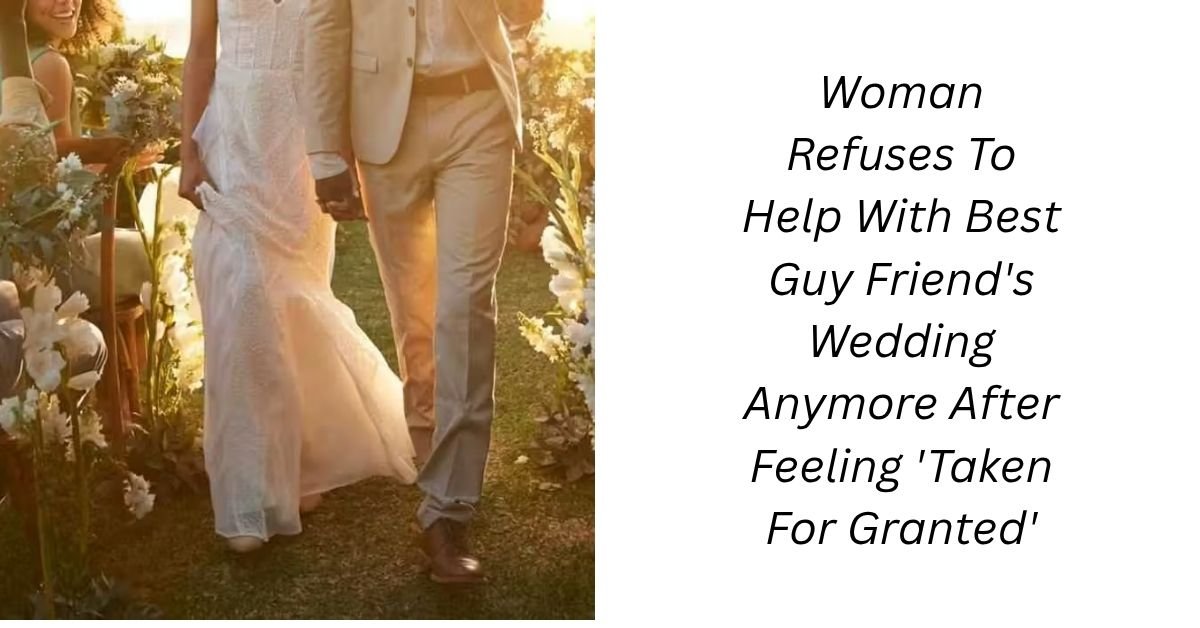
Woman Refuses To Help With Best Guy Friend’s Wedding Anymore After Feeling ‘Taken For Granted’
When this woman first agreed to help her best guy friend with his wedding, she was genuinely excited to be part of such an important moment in his life. They had been close friends for years, long before he met his fiancée, and she considered him one of the most important people in her life. Their friendship had always been based on trust, loyalty, and the understanding that they would support each other whenever needed. So when he asked her to help with wedding preparations, she did not hesitate. She knew weddings could be stressful, expensive, and overwhelming, and she wanted to make things easier for him. At first, everything felt completely normal. She helped brainstorm ideas, discussed decorations, looked over plans, and offered her opinion whenever he asked for it. She never expected anything in return. Helping him felt like something a close friend naturally did.
As the wedding planning continued, however, the amount of responsibility placed on her gradually increased. What started as occasional favors became regular tasks. Her friend began asking her to contact vendors, compare prices, organize schedules, review invitations, and help solve last-minute problems. Whenever something went wrong, she was often one of the first people he contacted. She tried not to complain because she understood that he was under pressure. She also knew that weddings involved countless details, and she wanted to be supportive. Whenever he thanked her, she felt reassured that her efforts were appreciated. But over time, she noticed that the requests were becoming less like favors and more like expectations. Instead of asking whether she had time to help, he would sometimes simply assume she was available. She started rearranging her own schedule around his wedding plans, believing that this was temporary and that he would eventually recognize how much she had done for him.
The situation became more frustrating when she began sacrificing things in her own life to accommodate him. There were evenings when she had planned to relax after work, only to receive a message asking her to handle another wedding-related task. There were weekends when she had personal plans that she ended up postponing because her friend suddenly needed help. She did not mind occasionally changing her schedule for someone she cared about, but the frequency began wearing her down. She also noticed that he rarely asked how she was doing. Most conversations started with another wedding problem. If she called him, he would immediately start discussing the venue, guest list, decorations, or some disagreement with his fiancée. Their friendship slowly became centered around the wedding instead of the things they had always talked about. She began missing the old version of their friendship, when they could spend hours joking, discussing life, or simply catching up without an agenda.
What hurt her most was not the amount of work itself but the feeling that her efforts were becoming invisible. At the beginning, her friend had repeatedly thanked her and told her that he could not imagine getting through the planning process without her. Months later, those words had disappeared. When she completed something, he simply moved on to the next request. If she solved a problem, there was rarely any acknowledgment. Instead, another task would appear. She started feeling less like a friend and more like an unpaid wedding assistant. She tried to tell herself that stress was changing his behavior temporarily, but the feeling continued to grow. She wondered whether he had become so focused on the wedding that he had stopped noticing the people helping him make it happen.
The breaking point came when her friend asked her to handle another major responsibility at the last minute. She already had something important planned for that day, but he acted as though she should naturally cancel it. When she explained that she could not do everything, he seemed genuinely surprised and asked why she was suddenly being difficult. That response hurt more than she expected. She had spent months saying yes, changing plans, solving problems, and making herself available whenever he needed her. Yet the moment she finally said no, he treated her like she was letting him down. She realized that perhaps the problem was not that she had helped too much, but that she had allowed her friend to become accustomed to her always saying yes.
Instead of arguing, she decided to have an honest conversation with him. She explained that she was happy for him and still wanted his wedding to be wonderful, but she could no longer continue handling so many responsibilities. She told him that she felt taken for granted and that their friendship had started feeling one-sided. She made it clear that she was not angry about helping. What hurt was the assumption that her time and energy were automatically available whenever he needed them. She reminded him that she had her own responsibilities, plans, and personal life. She also said that she missed being his friend instead of constantly feeling like someone working behind the scenes to keep his wedding organized.
Her friend initially became defensive. He said he had never intended to take advantage of her and claimed that he thought she was happy to help. He pointed out that she had always volunteered and rarely complained. She understood his argument, but she also felt that he was missing the point. Just because she had willingly helped in the past did not mean she had agreed to unlimited responsibility. She explained that people sometimes say yes because they care, even when they are becoming exhausted. She had expected him to notice that she was doing more and more, but instead, he had interpreted her willingness as unlimited availability. The conversation became emotional, but eventually he admitted that he had probably relied on her too heavily.
After that conversation, she decided to step away from the majority of the wedding planning. She told him that she would still attend the wedding, celebrate with him, and help with a few things that had already been specifically agreed upon, but she would no longer manage tasks that belonged to the couple. At first, she felt guilty about making that decision. She worried that people might think she was abandoning her best friend during an important period of his life. But as the days passed, she also felt an unexpected sense of relief. She finally had time to focus on her own life again. She stopped checking her phone constantly, stopped worrying about unfinished wedding tasks, and stopped feeling responsible whenever something went wrong. She realized how much emotional energy she had been spending without even noticing it.
Interestingly, stepping back also changed the friendship. At first, her friend seemed disappointed and slightly distant. But eventually, he began handling more responsibilities himself and relying more on his fiancée and other family members. Their conversations slowly returned to normal. They started talking about their lives again instead of discussing wedding logistics every time they spoke. The woman realized that setting a boundary had not destroyed their friendship. Instead, it forced both of them to recognize that friendship should not mean one person constantly sacrificing while the other simply accepts the help. Her friend eventually apologized for making her feel unappreciated and admitted that he had become so overwhelmed by the wedding that he had stopped thinking about how his requests affected other people.
Looking back, the woman does not regret helping her friend. She is still happy that she was there during such an important chapter of his life. What she regrets is allowing herself to become so overwhelmed before speaking up. She now believes that supporting someone does not mean saying yes to every request, and being a good friend does not require putting your own life permanently on hold. Her friendship with the groom survived, but it changed in an important way. She learned that healthy friendships need appreciation, communication, and boundaries from both sides. Most importantly, she realized that sometimes the best way to protect a friendship is to stop doing everything for the other person and give them the opportunity to appreciate what you actually contribute. In the end, she still wishes her friend a happy marriage—but she is no longer willing to sacrifice her own peace just to make his wedding easier.
Read Story…
“AITA for refusing to spend another day helping with my best friend’s wedding after feeling taken for granted?”
The Original Poster (OP) explained:
“This is more of an ethical dilemma than a fight.”
“I (F[emale] 26) have been best friends with ‘Adam’ (M[ale] 28) for years.”
“He’s getting married in two weeks, and I’ve been helping with the pre-wedding events wherever I can.”
“For context, I’m not a designer or wedding planner.”
“I just have a decent eye for aesthetics and know my way around Canva.”
“To help them save money, I volunteered to design their digital invites.”
“The first invite involved lots of revisions because family members kept remembering things they wanted added after it was supposedly final.”
“Before making the second invite, I specifically asked them to confirm all the content.”
“The bride sent me the text she wanted, and I used exactly that.”
‘Adam did not check with his family properly, and revisions were needed again.”
“After I sent the final version, Adam messaged our group chat asking, ‘Where’s the date on this invite?'”
“I was amused that everyone missed it despite so many versions and told him that it must have been missed because it wasn’t in the content I’d been given.”
“He replied, ‘Yeah, but that was common sense. You should’ve added it.'”
“That stung because I hadn’t even gotten a thank you, but blame was allotted rather quickly.”
“I apologized anyway to avoid drama on the group; he said it’s ok and moved on.”
“Later I told him privately that I didn’t like how he’d spoken to me.”
“He said he wasn’t blaming me, then added, ‘Why should I say thank you? Of course you’d do this for me. You’re my best friend.'”
“Yesterday (Saturday) he asked me to help with the wedding décor because he wasn’t happy with what the decorators had planned.”
“Last minute, when all families were there already, I was asked to quickly come down.”
“I spent 5 hours at the venue, and my inputs were the ones we chose finally.”
“When I left, he mentioned they might meet the decorator again today.”
“This morning (Sunday) he called asking, ‘Aren’t you coming?'”
“I told him I already had lunch plans.”
“He seemed surprised and said he thought it was obvious I’d be there because I’m ‘the designer.'”
“I’m not a designer.”
“I’m just a friend who’s been helping.”
“There have also been smaller things that add to this feeling.”
“Yesterday he was supposed to drop off my iPad.”
“He asked me to come downstairs, then completely forgot to stop at my place, leaving me waiting outside in the heat for 20 minutes before his driver eventually brought it back.”
“He’s an only child, and I’ve always treated him like the sibling he never had.”
“I genuinely enjoy showing up for my friends, and if he’d been showing more gratitude, I’d probably have gone.”
“But lately it feels less like, ‘Would you mind helping?’ and more like, ‘Of course you’re doing this.'”
The OP was left to wonder:
“So AITA for not going to today’s meeting to save my Sunday for me and feeling bothered that my time and effort seem to be expected rather than appreciated?”
Redditors shared their thoughts on this matter and weighed in on some options to the question, AITA:
- NTA – Not The A**hole
- YTA – You’re The A**hole
- NAH – No A**holes Here
- ESH – Everyone Sucks Here
- INFO – More Information Needed
Many Redditors declared that OP was NOT the A**hole.
“NTA. Have a face-to-face discussion with him; otherwise, it will escalate further.” ~ Riyokosan
“This. OP needs to have a talk with him about everything.”
“She has her own life, and she’s not even getting paid, so the entitlement is wild.” ~ Kisses4Kimmy
“I was initially surprised his fiancée tolerates him having you (a 2-year-younger-than-him-girl when he is a guy) as his best friend.”
“But then, as I read your post, I realised why she tolerates it: because he treats you like a servant (and not like a ‘friend’ that he is secretly pining for, and not even like a friend that he is not secretly pining for).”
“Try and do as little as possible for him now. NTA.” ~ Think-Corner-3232
“NTA. They’re acting as if you’re a professional, but you’re not.”
“Actually, whenever it’s convenient to them for you to be categorized as a professional, they act as if you’re a professional (AKA the constant revisions and assumptions of your time and energy); whenever it’s convenient for them for you to be categorized as a friend helping out, they act as if you’re a friend helping out (AKA they don’t pay you, they are rude to you).”
“And in both roles, they are very ungrateful.”
“I say this gently, but Adam and his family do not understand how much work you have given them, or respect how much time you have put into this already.”
“Your contributions are invisible and taken for granted. You own all the mistakes, and you are not the reason for any of the successes.”
You are NTA for stepping out of the constant stream of wedding preparations.” ~ whatnooh
“NTA, you need to have a ‘come to Jesus’ talk with him – no matter how obliged someone is to help you, or whether you assume someone ‘of course’ will help you, you still say thank you!!”
“This is incredibly rude of him to never say thank you.”
“And on top of that, he’s not doing the little things you’ve asked of him that make your job easier OR bothered to even give you a warning ahead of time when there’s a meeting, or bother to ASK you to join!?!”
“No, I’d be done.”
“Regardless of the conversation you have with him (or don’t), you should start imposing boundaries.”
“You are never available on less than 24 hr notice.”
“If he calls, you don’t answer, just text “can’t speak right now, what’s up?”
“And dont answer immediately” ~ SafetyFluid8535
“Every year for my birthday, my best friend gets me my favorite donut.”
“Sometimes it’s the morning of, sometimes it’s the night before or the day after, but she never forgets.”
“And you know what I have never said?”
“‘Of course you’re going to do this for me.'”
“I just feel grateful to have such a thoughtful friend.”
“And this is a freaking donut.”
“There is no excuse for this kind of entitlement in a friendship.”
“This person does not appreciate you.”
“When people tell you who they are, believe them.” ~ WildOneM13
“NTA. I’d step back.”
“You already told him how his behavior made you feel, and instead of apologizing or showing appreciation, he doubled down and acted like your help was automatically owed to him.”
“Keep your lunch plans and let him handle the wedding arrangements he chose not to properly organize.” ~ Maleficent-Shop-7178
“NTA. This man is not treating you with respect or love towards you or what you do for him.”
“That’s not a friend, that’s a client. If that’s how he wants to behave, maybe a bill for your services might be necessary.”
“His expectations of what he wants you to do are not okay and are not what a friend should do to another friend.” ~ EyeConstant1216
“Of course you would do his bidding however and whenever he wants???”
“And he has no reason to be grateful???”
“This person isn’t your friend, and his family and fiancée are users too.”
“Stop being involved in the wedding.”
“Whether you go or not, don’t spend any additional time or money on these people.”
“You are supposedly his friend, not an indentured servant.
“NTA.” ~ Jealous-Contract7426
“You feel taken advantage of because you were unclear about what you volunteered to do.”
“In your mind, you volunteered to help design the invitation once, not repeatedly and not to proofread it. However, you didn’t make that clear.”
“In your friend’s mind, you volunteered to make the perfect invitation, and of course that includes revisions and proofreading vital information.”
“In your friend’s mind, he asked you to help make the flowers perfect.”
“And of course, a meeting with the person actually doing the flowers would be needed.”
“In your mind, you volunteered to help once and done.”
“Your communication styles are different and unclear.”
“You are acting taken advantage of, but the issue is lack of clarity.” ~ Witty_Candle_3448
“NTA, but it’s not the greatest idea to volunteer to help with this kind of wedding planning, unless you’re prepared exactly for this.”
“For better or worse, heh, the bride and groom get to make their wedding day and wedding all about them.”
“It’s a lot of work.”
“On top of the actual couple, you also have parents and other family needing to get involved.”
“Next time, get them a nice gift but don’t volunteer for a job where you could be 1000% perfect and still get grief.”
“Another option is to volunteer to pay for their invites.” ~ authorinthesunset
“For better or worse, just like a marriage, you are in this now.”
“Eventually, they will run out of things to revise and get married, so accept the fact that they can’t get to the finish line without you.”
“Don’t expect much in the way of thanks, but know that the fact that they are depending on you is as close to showing appreciation as they can come until the wedding is over.” ~ Aggravating-Mix-4903
Reddit understands your feelings, OP.
Your friend is out of line.
A simple thank you wouldn’t kill him.
Don’t be afraid to stand up for yourself.
Good Luck.