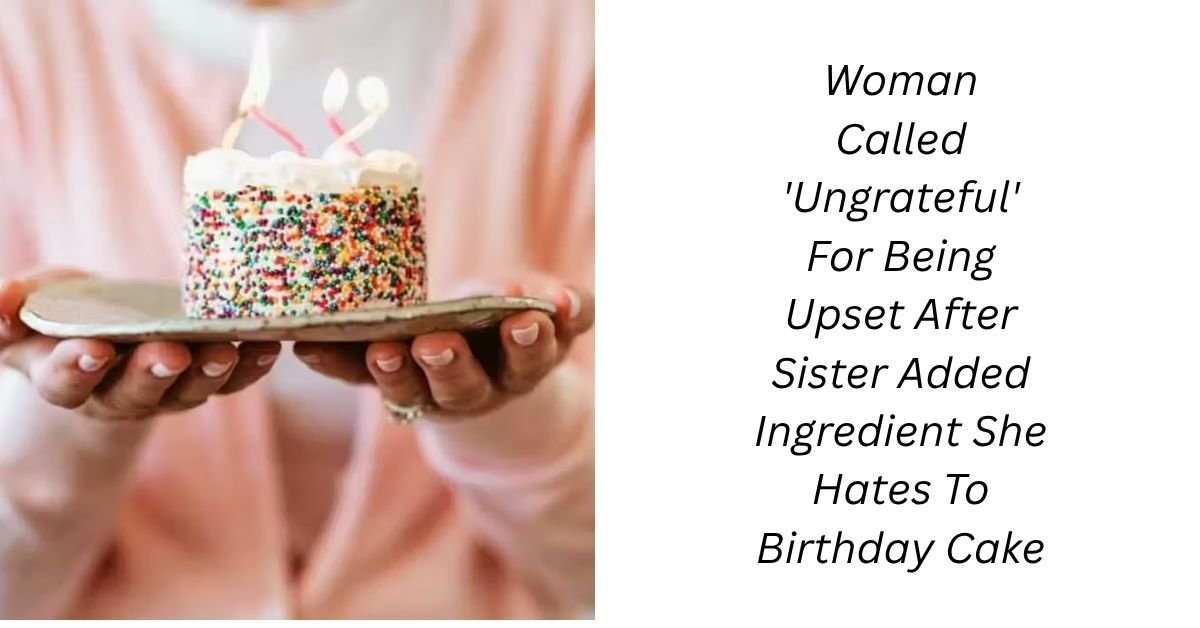
Woman Called ‘Ungrateful’ For Being Upset After Sister Added Ingredient She Hates To Birthday Cake
When this woman’s birthday arrived, she was looking forward to celebrating with her family and enjoying a cake that felt special to her. Birthdays are often about the little details that make someone feel remembered, and she had always been very clear about one particular ingredient she strongly disliked. It wasn’t something she casually avoided or merely preferred not to eat. She genuinely hated the taste and had made her feelings about it known to her family before. Because her sister was responsible for bringing or preparing the birthday cake, the woman assumed that her sister would remember this simple preference. She never expected the celebration to turn into an uncomfortable family disagreement. When the cake was finally revealed, however, she discovered that her sister had added the exact ingredient she had repeatedly said she hated. At first, she tried to stay calm because she didn’t want to ruin her own birthday or make everyone uncomfortable. But seeing something she had specifically asked to avoid in the cake left her disappointed, especially because she believed her sister knew how strongly she felt about it.
The woman explained that her reaction was not simply about being picky or demanding. She felt hurt because the ingredient could easily have been left out, and there were plenty of other options that would have allowed everyone to enjoy the cake. From her perspective, a birthday cake is supposed to be made with the birthday person’s preferences in mind. She wasn’t asking her sister to create something extremely complicated or expensive. She simply expected her sister to remember one basic thing she disliked. When she quietly expressed her disappointment, though, the response from some family members was not what she expected. Instead of understanding why she was upset, they accused her of being ungrateful. They pointed out that her sister had taken the time to make or arrange the cake and suggested that she should focus on the effort rather than complain about one ingredient. This made the woman feel even worse because she wasn’t trying to insult her sister’s effort. She appreciated that someone had taken the time to celebrate her, but she also believed that appreciation did not require her to pretend she liked something she genuinely disliked.
The disagreement quickly became bigger than the cake itself. The woman felt that her family was ignoring the reason behind her reaction and focusing only on the fact that she had complained. She wondered whether she was expected to smile, accept the cake, and say nothing simply because it was her birthday. In her mind, there was a difference between being grateful and being expected to tolerate something that could have easily been avoided. She also started questioning whether her sister had accidentally forgotten her preference or had intentionally included the ingredient for some reason. If it had been an honest mistake, she believed she could have understood that, especially if her sister apologized and admitted that she had forgotten. But if her sister knew exactly how much she hated the ingredient and still decided to add it, the situation felt much more personal. The woman didn’t want her birthday celebration to become a family argument, but being called ungrateful made her feel as though her feelings didn’t matter. She also found it frustrating that nobody seemed willing to acknowledge the simple fact that she had clearly communicated her preference beforehand.
As the discussion continued, different family members began taking sides. Some believed the woman should simply have accepted the cake and moved on because the intention behind it was supposedly positive. They argued that birthdays should be about appreciating loved ones and that complaining about an ingredient could make the person who prepared the cake feel unappreciated. Others understood the woman’s perspective and felt that her sister should have made more of an effort to respect such a basic request. They pointed out that if someone knows a person strongly dislikes a particular ingredient, deliberately adding it to their birthday cake is at least inconsiderate, even if there was no malicious intention behind it. The woman herself remained caught between these two perspectives. She didn’t want to appear spoiled or entitled, but she also didn’t think she should have to hide her disappointment just to protect someone else’s feelings. What bothered her most was not necessarily that the cake contained the ingredient. It was the way her reaction was dismissed afterward. Instead of having a simple conversation about what happened, she was labeled “ungrateful,” and that accusation made the entire celebration feel uncomfortable.
In the end, the situation raised a larger question about gratitude, boundaries, and consideration within families. Being grateful for someone’s effort does not necessarily mean enjoying every decision they make, and expressing disappointment does not automatically make someone ungrateful. At the same time, family celebrations can become tense when people feel that their efforts are being criticized rather than appreciated. The woman believed she could acknowledge her sister’s effort while still honestly saying that she was disappointed by the ingredient. Whether her sister forgot, misunderstood, or knowingly ignored her preference remained an important part of the disagreement. What seemed like a small issue involving a birthday cake ultimately became a conversation about whether family members truly listen to one another. For the woman, the experience was especially painful because her birthday was supposed to be a happy occasion. Instead of feeling celebrated and understood, she ended up defending herself against accusations that she was selfish and ungrateful. The incident left her wondering whether expecting someone to remember one simple food preference was really asking too much—or whether her family should have shown a little more consideration before turning her disappointment into a character judgment.
Read Story…
“AITAH for disliking the cake my sister made for my birthday?”
The original poster (OP) explained:
“My (29 F[emale]) birthday was last week, and I had a big party.”
“I was talking to my sister (31 F) about a cake that I wanted for the party and asked her if she had any recommendations of where I could order it from.”
“She insisted that I shouldn’t order the cake but instead let her bake it for me.”
‘I said I was happy to order and pay for someone to make it, but she insisted.”
“She’s a great baker, so I agreed.”
“She did two test runs of the cake to make sure it was right, and both tests were fabulous.”
“She nailed it.”
“However, she was convinced that it needed one extra ingredient, one that I really dislike and that changes the whole flavor of the cake.”
“Think adding coffee to a vanilla cake – that’s how extreme the change is.”
“She asked me about it twice, and I said no both times.”
“I don’t like the flavor, and I don’t want it in my cake.”
“Well, the birthday party comes, I cut into the cake, and I can immediately tell she’s added the ingredient that I asked her not to.”
“My husband also noticed immediately (it changed the color of the cake, so it was obvious!), and he asked her what happened.”
“She said, ‘It clearly needed the extra flavor to break it up, so I added it.'”
“I know it’s so stupid to get upset over a cake, but I was really frustrated.”
“She saw in the moment that I was annoyed and immediately got defensive about it.”
“Now, she’s saying I’m ungrateful for all the effort and time and money she spent making me this cake.”
“And I feel upset that I couldn’t just have what I wanted on my birthday, especially when she asked me, twice, if I wanted the change and I said no.”
“It cost her more to add in the ingredient I don’t enjoy.”
“It was more effort.”
“Should I just be grateful that she made me something that everyone else said tasted good, even if it wasn’t what I wanted?”
The OP was left to wonder:
“So, AITAH for being annoyed?”
Some Redditors weighed in by using the AITA voting acronyms:
- NTA – Not The A**hole
- YTA – You’re The A**hole
- NAH – No A**holes Here
- ESH – Everyone Sucks Here
- INFO – More Information Needed
Redditors decided the OP was NOT the A**hole here.
“NTA… she’s the one that decided to change the flavor after you told her no twice.” ~ dessertchef11
“Oh, I personally would love a lemon cake with a layer of blueberry jam or so in between; I think that sounds delicious!”
“But OP is NTA, but the sister absolutely is.”
“I make birthday cakes for my kids, my ex-husband, my partner, etc and I always make sure that everyone gets the cake they wish for, and I would never change or add an ingredient I know they don’t like.”
“What a shi*ty thing to do.”
“OP’s sister did this on purpose.” ~ Disastrous-Capybara
“Agree NTA.”
“She may have meant well, but for her, not you as much.”
“Made it more about her tastes.”
“I suddenly have a flashback to that weird 70’s song ‘someone left the cake out in the rain, and it took so long to bake it, but I don’t think I can fake it.”
“She did spend a lot with prior ingredients; appreciate that, but ignoring your no’s that’s on her.”
“She wanted to test a recipe and debut at your party, it sounds like.” ~ Proper-District8608
“NTA. Thanks but no thanks.”
“She knows why.” ~ Top-Bit85
“Yeah, agreed.”
“Like I ask my hubs what cake he wants for his birthday.”
“Always red velvet.”
“He always gets it.”
“But I can only imagine his reaction if one year he got a normal sponge cake or strawberry.”
“He would be internally devastated, and it would show on his face.”
“Sorry OP, but your sister did this deliberately to ‘showcase her skills’ as a baker.”
“Not for you and your birthday.”
“She sucks.”
“NTA and buy yourself a lemon cake.”
“It was one of our tiers on our wedding cake and by far my favorite!!!” ~ fergie_89
“Right, my stepdad usually does chocolate (which I’m fine with) or some kind of Ice Cream cake, which I don’t like.”
“Unlike OP’s sister, I’m mature enough to know that the birthday person gets all the decisions when it comes to their cake; I either eat a small piece or just don’t have cake.”
“NTA, OP, your sis is wrong on this.” ~ Potatoes0p
“NTA. Don’t let her bake a cake for you again.” ~ Equivalent_Lemon_319
“This is really important.”
“Hold this line.”
“My kids have had so many birthday cakes ruined because we thought the well-meaning family chef would hear, understand, and care that they didn’t want something fancy.”
“Similar, like a lemon curd layer between vanilla instead of just buttercream.”
“They all hated it for years until we could convince everyone to let us just order something.”
“Some people just ‘know better’ and don’t care.” ~ Pixie_786
“NTA – You said no twice, and she added it anyway.”
“If you had ordered it from a bakery, they would’ve actually made it how the customer wanted.”
“Additionally, you paid her for it.”
“You don’t just get to make whatever YOU think is best when you’re being paid to do something.” ~ ghostcraft33
“I had a similar situation with a birthday cake and my own mom.”
“I was very disappointed and afterwards told her that letting me make my own choices on my birthday is a great gift.”
“I’ve ordered my own birthday cake several times now.”
“And her changes weren’t even with something I actively disliked.”
“NTAH and don’t let your sister get it twisted.”
“She could have kept the berry compote separate for people to drizzle on the cake.”
“I’m wondering if she had some social media purpose for doing this.” ~ SmoothLester
“NTA, but what is the flavor?”
“I’m dying to know.”
“Sounds like she made the cake for herself, seeing as though you asked not to add that ingredient.” ~ DDD8712
OP came back with an Update…
“Ok, I was intentionally vague about the flavor in case she sees this post, but I’ve said it in comments, so oh well.”
“I wanted a lemon cake, and she added blueberry/blackberry compote that she made from scratch.”
“I just hate the flavor of blueberries, always have.”
“So, I cut into the cake expecting it to be yellow, like a lemon, and it was bright purple.”
“You couldn’t taste lemon at all, but you sure could taste blueberries.’
“For those asking, I didn’t actually say anything in the moment because I didn’t want to ruin the vibe, but I definitely made a face.”
“For sure.”
“And since she’d done two test runs that others had tried, they were also like, ‘Hey, why is the cake purple inside now?’ thinking that maybe I’d changed my mind or something.”
“My sister clocked my reaction, and my husband straight up asked her why the cake was a different color, and she said it needed the extras.”
“Then she got upset because enough people thought the situation was weird and she’s been talking about it ever since.”
“I did say to her (privately) later that night that I didn’t like her adding the extras when I’d asked her not to, and she launched into a whole thing about how I’m ungrateful, and it’s not all about me because others would also be eating it, and so on.”
“And since I’ve heard from other people that she’s still upset and that I should be grateful she did make me something and reminding me that ‘it’s just cake.'”
“I am not bringing it up to anyone unless they bring it up to me what she’s been saying all week.”
“So the AITAH is a genuine question since, yeah, it is just cake and probably not worth all this.”
“For those saying it sounds like she hates me and she wanted me to hate the cake: I genuinely don’t think this is it.”
“I think she was so convinced her way was the best way and that I would see it if I just tried it.”
“I did not agree.”
“I also think she considered this version to be more impressive, because she talked so much about how she made the compote from scratch.”
“She wanted people to be impressed – and they were! – but I was not.”
“I hate blueberries.”
“Since this has come up a lot: Why two test runs?”
“She’s very Type-A and needs things to be correct (to her).”
“I had about 50 people at my birthday, so she probably felt some pressure.”
“The first one came out soggy, in her opinion.”
“In my opinion, it was delicious and perfect, and she wanted to change the lemon curd to the compote because it ‘sets differently.'”
“I said no.”
“The second one she was happy with structure-wise, but this time she wanted to add the compote for flavor depth. I said no again.”
“I was so happy with what she’d made and told her so over and over.”
“So, imagine my surprise when the cake is purple at my party!”
Reddit agrees with you, OP.
This wasn’t her birthday; it was your birthday.
Let her save her compote for her special day.
Go indulge in some great lemon cake.
Woman Expects A Simple Birthday Celebration, But Her Sister Adds The One Ingredient She Hates
When this woman’s birthday finally arrived, she was expecting a simple celebration with the people she loved. She wasn’t looking for anything extravagant or expensive. All she wanted was to spend some time with her family, enjoy a nice meal, and have a birthday cake that she could actually enjoy. She had always been very open about one particular ingredient that she absolutely hated. It wasn’t just a mild preference or something she occasionally avoided. She genuinely disliked the taste and had mentioned it to her family several times over the years. Because her sister was involved in arranging the birthday cake, she assumed that this small preference would be remembered. Unfortunately, when the cake appeared, she discovered that her sister had included the exact ingredient she couldn’t stand.

Advertisement
At first, the woman tried not to react too strongly. She understood that her sister had presumably spent time and effort preparing or arranging the cake, and she didn’t want to immediately turn a happy birthday gathering into an argument. She looked at the cake and realized that the ingredient wasn’t something she could simply ignore. Depending on how it had been incorporated, removing it might not even have been possible without ruining the cake. She felt disappointed because she had imagined enjoying a dessert chosen with her preferences in mind. Instead, she was suddenly faced with something she knew she wouldn’t enjoy eating.
The woman explained that she had never demanded that everyone else stop eating the ingredient. She didn’t expect her entire family to change their diets because of her dislike. Her only expectation was that, on her birthday, the cake made specifically for her would not contain it. To her, that seemed like a very reasonable request. If the ingredient had been difficult to avoid or essential to the recipe, she might have understood. But she believed there were plenty of alternative flavors and recipes available. That was why its presence in her birthday cake felt particularly disappointing.
What bothered her most was that her sister already knew about her dislike. This wasn’t a situation where the woman had never mentioned it and expected everyone to somehow know. She had apparently told her sister before that she couldn’t stand the ingredient. Her sister had heard her complain about it and knew she would normally avoid desserts containing it. Because of that history, the woman couldn’t help wondering whether her sister had simply forgotten or whether she had made a conscious decision to include it anyway.
When she finally commented on the cake, she tried to explain her feelings rather than attack her sister. She acknowledged the effort involved in preparing the celebration and said that she appreciated the gesture. At the same time, she admitted that she was disappointed because the cake contained something she strongly disliked. She wasn’t demanding that her sister throw the cake away or make an entirely new one. She simply wanted her family to understand why she wasn’t excited about eating it. Unfortunately, her honesty was interpreted very differently.
Instead of receiving sympathy, the woman was quickly called “ungrateful.” Her sister apparently felt that the woman was focusing too much on what was wrong with the cake instead of appreciating the work that had gone into making her birthday special. Other relatives agreed and suggested that she should have simply smiled, thanked her sister, and moved on. They argued that the cake was a gift and that complaining about one ingredient made her appear entitled. Hearing this made the woman question whether she had handled the situation incorrectly.
She understood why someone might think she should be grateful. Her sister had taken the time to participate in her birthday celebration, and the woman didn’t want to dismiss that effort. However, she also felt that gratitude and disappointment could exist at the same time. She could appreciate the gesture without pretending to enjoy every aspect of it. To her, being grateful didn’t mean she had to lie about how she felt. She believed she should be allowed to say that she was disappointed without being labeled a bad person.
The situation became even more confusing because the woman wasn’t demanding special treatment from everyone else. She wasn’t telling her sister that nobody else could eat the cake. She wasn’t asking for an expensive replacement. She wasn’t even insisting that the entire birthday celebration be changed. She simply wished the cake had been made without one ingredient she hated. In her mind, that was a small accommodation, especially considering that the cake was supposed to be for her birthday.
Her sister, however, seemed to feel that the woman’s reaction was an insult. From the sister’s perspective, she had tried to do something thoughtful and was being criticized for it. She may have felt embarrassed or hurt when the woman expressed disappointment in front of the family. Even if the ingredient had been included accidentally, the woman’s reaction could have made her sister feel that her effort wasn’t appreciated. This created a situation where both women felt hurt for completely different reasons.
The woman later wondered whether she should have said nothing at all. Maybe she should have simply thanked her sister, avoided eating the cake, and dealt with her disappointment privately. But she also felt that staying silent would have meant allowing the situation to happen without ever communicating how she felt. She didn’t want resentment to build up. If her sister had genuinely forgotten about the ingredient, she wanted her to know so the same thing wouldn’t happen again.
Another issue was the way the family handled the disagreement. Instead of asking what had happened or whether the ingredient had been included accidentally, several people immediately criticized the woman. They treated her reaction as evidence that she was spoiled or difficult. This made her feel as though the entire family had decided she was wrong before hearing her side. She believed the situation could have been resolved much more easily if someone had simply acknowledged her disappointment.
The woman also questioned whether people would have reacted differently if the situation involved an allergy or dietary restriction. Obviously, an allergy would be a much more serious matter, but she wondered whether people sometimes dismiss strong food dislikes simply because they don’t consider them important enough. Just because someone can technically eat something doesn’t mean they have to enjoy it. She felt that her family was treating her preference as meaningless simply because it wasn’t medically necessary.
For her, the birthday cake represented something symbolic. Birthdays are often moments when people feel especially seen and appreciated. Small details can make a person feel that others truly know them. Remembering someone’s favorite flavor or avoiding something they hate can be a simple way of showing consideration. That’s why she felt disappointed when the opposite happened. She wasn’t expecting perfection, but she had hoped her sister would remember something so basic.
The woman also began thinking about whether this was part of a larger pattern between her and her sister. She wondered if there had been previous occasions when her preferences were ignored or dismissed. Sometimes one isolated incident can hurt more because it reminds someone of several smaller experiences that happened before. She didn’t necessarily believe her sister was intentionally trying to hurt her, but the cake incident made her question how much attention her sister actually paid to what mattered to her.
Some relatives argued that the woman’s birthday should have been about family togetherness rather than the cake itself. They told her that she should focus on the fact that everyone had gathered to celebrate her. The woman understood that argument, but she felt it missed the point. She wasn’t rejecting the entire celebration. She was upset about one specific detail and the way her feelings were treated afterward. She could appreciate being surrounded by family while still being disappointed by the cake.
Others supported the woman and believed her sister should have known better. They pointed out that making a birthday cake without an ingredient the birthday person hates isn’t an unreasonable expectation. If there were dozens of possible cake options, why choose one that included something she had openly said she disliked? Even if it was an innocent mistake, they felt the sister could have simply apologized rather than accusing the woman of being ungrateful.
The disagreement also highlighted the difference between intention and impact. Her sister may have intended to do something kind, but the result still disappointed the woman. Good intentions don’t automatically erase the effect an action has on someone. At the same time, the woman’s disappointment didn’t necessarily mean her sister had malicious intentions. Both things could be true: the sister could have meant well, and the woman could still have been genuinely upset.
Eventually, the woman realized that she didn’t need to choose between being grateful and being honest. She could thank her sister for the effort while explaining that the ingredient had made the cake difficult for her to enjoy. She didn’t have to insult the cake, criticize her sister’s abilities, or demand a replacement. A calm conversation could have communicated her feelings without turning the situation into a larger conflict. Unfortunately, once the word “ungrateful” entered the conversation, it became much harder to keep things calm.
The label affected her more than the cake itself. Being called ungrateful made her feel as though her entire personality was being judged based on one reaction. She believed she had a right to be disappointed without being portrayed as someone who never appreciates anything. She wondered how many times she was expected to suppress her genuine feelings simply because someone else had made an effort. To her, healthy relationships should allow people to communicate disappointment without immediately attacking their character.
She also recognized that her sister may have felt genuinely hurt. If someone spends time preparing a birthday surprise and the recipient immediately points out a flaw, it can be difficult not to take that personally. The woman could understand her sister’s feelings even though she didn’t agree with the way the situation was handled. She wished they could have discussed the mistake without turning it into a debate about who was more deserving of sympathy.
The woman eventually decided that the bigger issue was not whether she liked the cake. It was whether her family respected her enough to listen when she communicated a preference. She wasn’t asking everyone to agree with her taste. She simply wanted her feelings to be taken seriously. If she said she hated an ingredient, she hoped her loved ones would remember that when preparing something specifically for her.
There was also a lesson about expectations surrounding gifts. Some people believe that once someone gives you something, you have no right to criticize it. Others believe that the recipient is allowed to have preferences and express disappointment respectfully. The woman found herself somewhere in the middle. She didn’t believe people should be rude about gifts, but she also didn’t believe receiving a gift meant surrendering the right to have an honest reaction.
Looking back, she admitted that perhaps she could have handled her initial reaction more carefully. She could have waited until later to discuss the issue privately with her sister instead of allowing her disappointment to become part of the celebration. At the same time, she felt that her family could have shown more empathy. Rather than immediately calling her ungrateful, they could have asked whether she was hurt because her known preference had been ignored.
The entire experience left her with mixed emotions about future celebrations. She still loved her family and didn’t want one cake to permanently damage her relationship with her sister. However, she also wanted to establish that her feelings mattered. She hoped that future birthdays could be handled with more communication and consideration. If her sister had simply acknowledged the mistake and said she hadn’t realized how strongly the woman felt, the disagreement might have ended almost immediately.
Ultimately, the story raised an interesting question about what gratitude really means. Is a person required to pretend to enjoy something simply because someone else made an effort? Or can they appreciate the thought while honestly acknowledging that the result wasn’t what they wanted? In this woman’s case, she believed the second option was perfectly reasonable. She appreciated that her sister wanted to celebrate her, but she couldn’t force herself to like an ingredient she genuinely hated.
The incident may have started with a birthday cake, but it became a much deeper argument about consideration, communication, and family expectations. The woman didn’t believe she was entitled to perfection, nor did she expect everyone to cater to her preferences. She simply wanted one small thing on her birthday to reflect something her family already knew about her. Being called “ungrateful” made the disappointment much worse because it turned a minor issue into a judgment about her character.
In the end, the woman was left wondering whether she had truly done something wrong by expressing her feelings. Some people believed she should have kept quiet and appreciated the gesture, while others felt that her sister should have respected a clearly stated preference. The answer may depend on how the conversation actually happened and whether the ingredient was added intentionally or by mistake. But one thing seemed clear: a thoughtful gesture doesn’t automatically become meaningless because the recipient is disappointed, just as disappointment doesn’t automatically erase the effort someone made. For this woman, the real hope was that her family would learn to separate those two things and understand that appreciation and honesty can exist together.