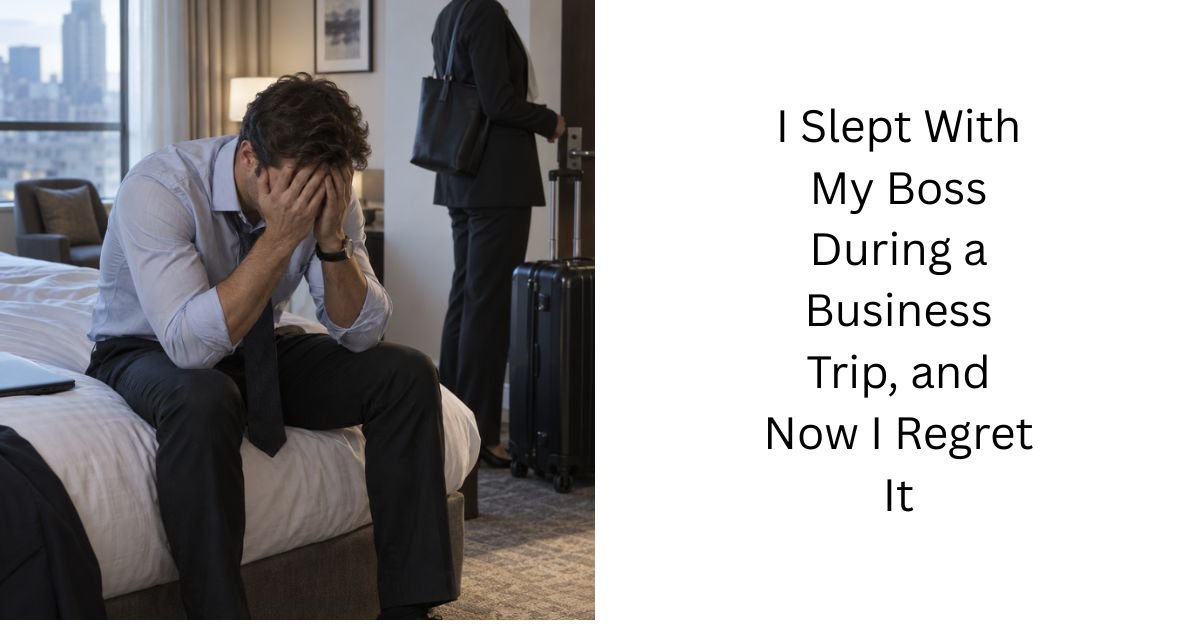
I Slept With My Boss During a Business Trip, and Now I Regret It
When I accepted the business trip with my boss, I honestly thought it would be nothing more than another exhausting work assignment. I had been working at the company for almost four years, and my relationship with my boss had always been professional. We disagreed about deadlines, joked occasionally during stressful meetings, and sometimes stayed late to finish important projects, but I had never seriously considered him in any other way. The trip was supposed to be an opportunity for us to meet an important client, give a presentation, and hopefully secure a contract that our entire department had been working toward for months. Instead, what happened during those few days completely changed the way I looked at my job, my boss, and even myself. The first day went exactly as planned. We spent most of the day in meetings, discussed numbers over dinner, and returned to the hotel exhausted. But the next evening, after the client meeting had gone surprisingly well, my boss suggested we have a drink to celebrate. I agreed without thinking much of it. We talked about work at first, then our families, our personal lives, and the pressures we had both been dealing with. The conversation became unusually personal, and somewhere between the laughter and the drinks, the professional boundary between us began to disappear.
I remember realizing that something had changed, but instead of stepping away, I stayed. He told me things about his life that I had never heard before, including how lonely he had been feeling and how much pressure he carried as someone responsible for an entire team. I told him about my own frustrations, my relationship problems, and the uncertainty I had been feeling about my future at the company. Looking back, I think the emotional vulnerability was more dangerous than the alcohol. We were both saying things that probably should never have been discussed between a manager and an employee. There was a moment when the conversation became quiet, and we looked at each other differently. I knew there was a line between us, and I knew crossing it could create problems, but I convinced myself that I was overthinking everything. What happened afterward was a decision made in a moment when neither of us seemed interested in thinking about the consequences. I spent the night with him. I am not going to describe the intimate details because those details are not really what matter. What matters is that the next morning, I woke up with a terrible feeling in my stomach. The room looked exactly the same, but everything felt completely different.
He was already awake when I opened my eyes, and the awkwardness was almost unbearable. Neither of us knew what to say. Eventually, he told me that we should forget about what happened and focus on work. I agreed because, at that moment, pretending it had never happened seemed easier than facing what it could mean. We returned home two days later, and I tried to go back to my normal routine. I told myself that it had been a mistake, a strange moment created by travel, stress, exhaustion, and emotions. I promised myself that it would never happen again. But returning to the office made everything much harder. Suddenly, every meeting with him felt different. When he walked into the conference room, I remembered the hotel. When he asked me to stay behind after a meeting, my heart started racing because I wondered whether he was going to bring up that night. I also noticed that he seemed uncomfortable around me. He became unusually formal and started communicating with me mostly through emails instead of speaking privately. At first, I thought that was a good thing. Then I began worrying that perhaps he regretted it too—or worse, that he was afraid I might tell someone.
The situation became even more complicated when I noticed subtle changes in how he treated me professionally. Sometimes he seemed distant, while other times he gave me more attention than before. I started questioning every decision he made involving me. If I received praise, I wondered whether it was because of my work or because of what happened between us. If I was left out of a meeting, I wondered whether he was punishing me. I realized that the incident had created a problem I could not simply erase. The worst part was that I had always been proud of my career. I had worked hard to earn my position, and I wanted my colleagues to respect me because of my abilities. Now I felt like one mistake had made everything uncertain. I also started thinking about the power imbalance between us. Even though I had made my own decision that night, he was still my boss. He had influence over my assignments, evaluations, opportunities, and future at the company. That realization made me uncomfortable in a way I had not expected. I began wondering whether I could ever feel completely independent at work again.
A few weeks later, the situation finally reached a breaking point. He asked me to meet privately in his office, and I immediately assumed he wanted to discuss the business trip. Instead, he told me that he thought we needed clearer boundaries going forward. He said that what happened had been a mistake and that neither of us could allow it to interfere with work. Hearing him call it a mistake hurt more than I expected, even though I knew that was probably the right way to describe it. I told him I agreed, but then I asked him whether he understood how difficult the situation was for me as his employee. He became quiet. I explained that I did not want special treatment, punishment, or awkwardness. I simply wanted to be able to do my job without constantly wondering whether my career was being affected by something that happened outside the office. He admitted that he had been worried about the same thing. For the first time, we openly acknowledged that our decision had consequences beyond the two of us. We agreed to keep all communication professional and to avoid situations where we would be alone together unnecessarily.
For a while, things improved. I focused on my work and tried to stop replaying the business trip in my head. I started spending more time with coworkers and became more involved in projects that did not require direct interaction with him. Slowly, I began feeling like myself again. But regret is strange because it does not always disappear simply because life moves forward. Sometimes it returns when you least expect it. I regretted the decision because it had complicated something that had once been simple. I regretted putting myself in a situation where my personal choices could affect my professional future. Most importantly, I regretted allowing one emotional moment to override the judgment I had spent years developing. I did not hate my boss, and I did not believe he was entirely responsible for what happened. We were both adults, and we had both made the choice. But I also understood that the consequences were not equal because he held more power than I did at work. That imbalance was something I should have considered before crossing the line.
Now, months later, I am still trying to decide what the right next step is. My performance at work has remained strong, but I no longer feel completely comfortable there. Sometimes I think about transferring to another department. Other times I consider finding a new job altogether so I can finally leave the entire situation behind. The hardest lesson has been realizing that a single decision can change how you experience something that once mattered deeply to you. I cannot go back and undo that night. I cannot pretend it never happened, and I cannot control how my boss remembers it. What I can control is what I do next. I have learned that boundaries at work exist for a reason, especially when there is a difference in power. I have also learned that regret can be useful if you allow it to teach you something instead of letting it define you. I still wonder whether I should stay at the company and prove to myself that one mistake does not control my career, or whether leaving would give me the fresh start I need. Maybe there is no perfect answer. For now, I am simply trying to rebuild my confidence, protect my future, and make sure that whatever decision I make next is one I will not regret.
Read Story…
I messed up big time by sleeping with my female boss.
TL;DR – I slept with my female boss. She said it doesn’t mean anything and it never happened. But I am nervous every time I see her. I am in constant fear.
I can’t believe what has happened. She had always been a very professional. We always spoke about work and work alone. Recently I had to go to a different city (Delhi) along with her on an official visit and we spent 1 week over there. For the first 5 days we were super busy. We couldn’t even explore the city. And then the last 2 days were just extra days that we had on our hands to explore the city. We went out, visited few places in the city… still everything professional. She would crack jokes but nothing inappropriate, no personal questions or anything. We had dinner together.. that’s when she started to relax a bit, she started to ask me about my family, relationships.. but very politely and gently. There was no hint of interest.
One important point that I should mention is that when we were booking the hotel we had three options :
- Book two separate rooms in 5 star hotel
- Book one suite (it consisted of 2 rooms ) in a 4 star hotel.
- Book an executive suite in a 5 star Hotel for 2 days and spend the rest of the days anywhere out of our own pockets.
We booked the #1 for first 5 days. And the last 2 days were in #3. The very first night that we stepped inside after dinner into our executive suite .. we spent 2 hours just talking about random stuff, watching tv. Cracking jokes.. picking on colleagues. And then I said it’s late we should sleep, she went to her room in the same suite. And I went to take a shower. When I came back she was there sitting on my bed all dolled up.
I didn’t utter a word. She looked at my face and said.. Oh please don’t tell me you did not think of this. I thought a little and then I told her that this is a funny prank. She spent the next half an hour just trying to convince me that it’s not a prank but if I don’t want to do it.. it’s cool.
Then after half an hour she said “what can I do to make you believe it’s not a prank?”. Then she proceeded to remove her top. And that’s when I knew. It’s not a prank. We had sex. We had sex the next day. And then before we checked out she said.. this never happened. It was a dream. Don’t bring this up ever.
She meant it. She went back to being super professional as soon as we left the hotel.
She would never talk about it. I didn’t either but I am always nervous as hell when I see her. Always wondering if people know.
The Business Trip That Changed Everything
When I agreed to go on the business trip with my boss, I genuinely believed it would be nothing more than another work assignment. I had been with the company for several years, and although my boss and I worked closely together, our relationship had always been professional. She was demanding, intelligent, and extremely focused on results, while I was the kind of employee who preferred to keep my head down, finish my work, and avoid office drama. The trip was important because we were meeting a major client who could potentially bring our company a huge contract. Everyone in our department knew how much depended on that meeting. I was excited about the opportunity because I thought performing well could help my career. I never imagined that a few days away from the office would create a situation that would make me question whether I could continue working there at all.
The first day of the trip was completely normal. We spent most of the day meeting with the client, reviewing presentations, discussing numbers, and answering questions. By the time we returned to the hotel, both of us were exhausted. We had dinner together because it was easier than finding separate places to eat, and our conversation stayed focused on work. She talked about how important the client was to the company, while I explained some concerns I had about the presentation. She appreciated my honesty and told me that she trusted my judgment more than I probably realized. At the time, I took the comment as professional encouragement. Looking back, I realize that it was probably the first moment when the dynamic between us began to feel slightly different.
The second evening was when everything changed. The client meeting had gone extremely well, and my boss suggested that we celebrate with a drink. I agreed without thinking twice. We found a quiet place near the hotel and sat there talking much longer than either of us had planned. At first, the conversation was about the successful meeting and the company. Eventually, however, we started talking about our lives outside work. She told me about the pressure she felt as a manager and how difficult it was to constantly be responsible for other people’s careers. I shared some of my own frustrations and personal struggles. The conversation became more emotional than I expected, and there was a level of openness between us that had never existed in the office.
By the time we returned to the hotel, the atmosphere between us had completely changed. I knew there was a boundary that we should not cross, especially because she was my boss. I also knew that whatever happened could create serious consequences for both of us. But instead of listening to that voice in my head, I allowed myself to believe that perhaps I was imagining the seriousness of the situation. We were both adults, both emotionally vulnerable, and both caught up in the strange atmosphere of being away from home. One decision led to another, and eventually we spent the night together. I am not going to focus on the intimate details because that is not what this story is really about. The important part is that when I woke up the next morning, I immediately knew I had made a mistake.
She seemed to realize it too. The conversation the following morning was awkward and uncomfortable. Neither of us knew how to behave around the other. Eventually, she told me that we needed to forget what happened and continue working as though nothing had changed. I agreed because I desperately wanted to believe that was possible. I told myself that the trip was almost over, that we would return home, and that everything would eventually feel normal again. At that moment, pretending it had never happened seemed like the easiest solution. I did not understand that you cannot always erase something simply by refusing to talk about it.
When we returned to the office, I discovered just how difficult pretending could be. The first time I saw her sitting behind her desk, I felt an immediate wave of anxiety. Nothing about the office had changed. The same people were walking around, phones were ringing, emails were arriving, and everyone was talking about deadlines. Yet everything felt completely different to me. I could barely make eye contact with her without remembering the trip. I became painfully aware of every conversation we had. If she smiled at me, I wondered what she was thinking. If she looked serious, I wondered whether she regretted what happened. Even ordinary work instructions suddenly felt loaded with meaning.
For the first few days, she acted as though nothing had happened. She spoke to me professionally, assigned tasks, and participated in meetings just as she always had. I should have been relieved, but instead I became more nervous. Her calm behavior made me wonder whether I was the only person struggling with the situation. I started overanalyzing everything she said. If she asked me to stay after a meeting, I worried she wanted to discuss the night. If she sent me an email late at night, I immediately wondered whether it was personal. I knew most of these thoughts were probably irrational, but I could not seem to stop them.
The biggest problem was that I no longer knew how she saw me as an employee. Before the trip, I had always believed that my promotions and opportunities were based on my performance. Afterward, I started questioning everything. If she praised my work, I wondered whether she was trying to compensate for what happened. If she criticized me, I wondered whether she was angry with me. I hated feeling this way because I had worked hard to build my reputation. I did not want one personal mistake to make me question every professional accomplishment I had earned.
I also became increasingly aware of the power difference between us. She was my boss, which meant she had influence over my assignments, performance reviews, promotions, and future at the company. Even though what happened had been mutual, the professional consequences could still affect me differently. I began wondering whether I had put myself in a position where I could never feel completely comfortable again. Every time she made a decision involving my career, I wondered whether the decision was influenced by what happened between us.
One afternoon, I noticed that she had become unusually distant. She stopped joking with me and started communicating almost exclusively through email. At first, I assumed she was trying to protect both of us by creating professional distance. But then I started worrying that she might be angry or embarrassed. I found myself checking her tone in every message and reading emails multiple times before deciding how to respond. The situation was exhausting because nothing was actually happening, yet I was constantly preparing myself for something to happen.
Eventually, my anxiety began affecting my work. I started making small mistakes that I normally would have caught. I would reread simple emails five or six times because I was afraid of saying something that could be misunderstood. Meetings became stressful because I was constantly aware of where she was sitting. I even started avoiding opportunities to speak directly with her, which was ridiculous considering that communicating with my manager was part of my job. I knew I was allowing fear to control me, but I did not know how to regain my confidence.
The situation became worse when one of my coworkers casually mentioned that my boss seemed unusually serious lately. That innocent comment sent my mind into overdrive. I immediately wondered whether people had noticed something between us. I began imagining rumors spreading throughout the office. I knew nobody had any real evidence, but anxiety does not require evidence. It only requires uncertainty. For the first time, I realized how much I wanted to escape the entire situation.
A few weeks later, my boss asked me to come into her office for a private conversation. My heart started pounding the moment I received the message. I spent the entire morning wondering what she wanted to discuss. When I finally entered her office, she closed the door and told me that she believed we needed to establish clearer boundaries. She said that what happened during the trip had been a mistake and that neither of us could allow it to affect our professional relationship.
Hearing her say the word “mistake” was strangely painful. I already considered it a mistake, but hearing her describe it that way made the reality impossible to ignore. I told her that I agreed and that I wanted to move forward professionally. But I also admitted that I had been extremely nervous since returning from the trip. She looked surprised and said that she had noticed I seemed uncomfortable. I explained that I was afraid my career could be affected by what happened, even unintentionally.
She listened carefully and told me that she did not want me to feel threatened or punished because of the situation. She said she intended to keep everything professional and expected me to do the same. I appreciated hearing that, but I also realized that reassurance could not instantly remove the anxiety I had developed. Trusting that things would be normal again was going to take time.
After that conversation, things became somewhat easier. We kept our interactions professional and avoided unnecessary private situations. I stopped looking for hidden meanings in every conversation and focused more seriously on my actual responsibilities. Slowly, I began remembering why I had liked my job before the trip. I enjoyed the work itself, liked many of my coworkers, and had spent years building my career there. I did not want to throw all of that away because of one terrible decision.
Still, regret continued to appear at unexpected moments. Sometimes I would drive home from work and suddenly remember the hotel. Other times I would see my boss walking down the hallway and feel that familiar nervousness return. I hated that a place where I once felt confident could suddenly make me feel so uncomfortable. I began wondering whether I had permanently changed the way I viewed myself.
The hardest part was accepting that I could not undo the decision. I spent too much time imagining alternative versions of the trip. What if I had gone back to my room earlier? What if I had refused the drink? What if I had kept the conversation focused on work? What if I had recognized how vulnerable we both were? There were hundreds of possible choices, but none of them mattered anymore. The only thing I could control was what I did from that point forward.
I also realized that I had been relying too heavily on the idea that because we were both adults, the situation was simple. It was not. Workplace relationships can become complicated when one person has authority over the other. Even when both people make the same decision, the consequences can be very different. That was something I should have considered before allowing my emotions to override my judgment.
Eventually, I started rebuilding my confidence by focusing on things I could control. I became more organized, kept communication with my boss professional, and stopped putting myself in situations where boundaries could become unclear. I also started looking at my career independently from my relationship with her. I reminded myself that my skills, experience, and work ethic existed before that trip and would continue to exist afterward.
There were moments when I considered quitting. I thought about finding another company where nobody knew what had happened and starting over completely. The idea of never having to see her again was tempting. But I also questioned whether leaving would actually solve the problem or simply allow fear to make an important decision for me. I did not want to spend the rest of my life running away from every mistake I made.
At the same time, I understood that staying would require me to maintain strong boundaries. I could not allow guilt or embarrassment to determine my career choices. If I stayed, I needed to be confident that I could work professionally regardless of what had happened. If the situation ever became uncomfortable or affected my employment, I knew I would need to take appropriate steps to protect myself.
Months passed, and the intensity of my anxiety slowly decreased. Seeing my boss was no longer enough to make my stomach drop. We developed a professional routine that felt much more normal. We still worked together, but our conversations were focused on projects, deadlines, clients, and results. The memory of the trip did not disappear, but it stopped controlling every interaction.
Looking back, I do not think either of us fully understood what we were risking that night. We were caught up in a temporary situation and convinced ourselves that we could separate one night from everything else. The reality was that our professional relationship existed before that night and had to continue afterward. We could not simply press a button and return to exactly the same place.
I also learned that regret is not always a sign that your life is ruined. Sometimes regret is simply evidence that you have learned something important. I wish I had made a different choice, but I cannot change the past. What I can do is make sure I never put myself in the same position again. I can maintain boundaries, think about consequences, and remember that temporary emotions can create permanent complications.
Today, I am still working at the company, although I occasionally wonder whether that will always be the case. My relationship with my boss is professional, and I have worked hard to rebuild the confidence I had before the trip. I no longer spend every day wondering whether she is thinking about what happened. I have finally accepted that I cannot control what she thinks or remembers. I can only control my own behavior.
The biggest lesson I took from the experience is that workplace boundaries matter more than I once realized. A business trip can create a strange environment where normal routines disappear, but professional responsibilities do not disappear with them. I should have remembered that before crossing a line I knew existed.
If I could go back to that evening, I would make a completely different decision. I would thank her for the successful meeting, return to my room, and wake up the next morning without the weight of regret hanging over me. But life does not give us the opportunity to rewrite individual moments. All we can do is learn from them.
So now I am trying to stop punishing myself for one mistake and start focusing on the person I want to become afterward. I made a poor decision, faced the consequences, and learned a lesson that I will probably carry for the rest of my career. Maybe someday I will look back at this experience and see it simply as a difficult chapter that helped me become more careful and self-aware. For now, I am just grateful that the situation did not destroy everything I had worked for—and determined never to let one moment of poor judgment define the rest of my life.