Redditor Considers Quitting Job After Boss’s Response To Request For Time Off For Death In Family
I never thought I would seriously consider quitting my job because of something as basic as asking for time off after a death in my family. I have worked for my company for several years, and until recently, I had always considered myself a dependable employee. I rarely call in sick, I usually arrive early, and I make an effort to finish my responsibilities before leaving for the day. Even when work gets stressful, I have generally tried to be flexible when my manager needs extra help. Because of that, I never expected asking for a few days away during a family emergency to become such a major issue. Unfortunately, someone close to my family passed away unexpectedly, and I immediately knew I needed to be with my relatives. There were arrangements to make, family members to support, and a funeral that I wanted and needed to attend. I contacted my boss as soon as I could and explained the situation honestly. I wasn’t asking for an extended vacation or trying to take advantage of company policy. I simply needed some time to deal with something that was emotionally devastating.
When I approached my boss about taking time off, I expected at least a basic level of understanding. Instead, his first response was surprisingly cold. He asked whether the timing was really necessary and whether someone else could “handle” the family situation without me. I was caught off guard by the question because this wasn’t a casual personal appointment that I could simply reschedule. I explained that there had been a death in my family and that I needed to be present for the funeral and to support my relatives. Rather than expressing sympathy, my boss immediately started talking about how my absence would affect the team’s workload. He asked me to explain exactly why I needed several days instead of just taking one day. I told him that I understood work was important, but I was dealing with a death and didn’t think I should have to defend why I needed time away. The conversation left me feeling incredibly uncomfortable, especially because I had always tried to be a responsible employee.
The situation became worse when my boss suggested that I should reconsider taking the full amount of time I had requested because the company was busy. He reminded me that deadlines were approaching and said that everyone had personal problems but still had responsibilities. That statement really bothered me. I understood that my absence could create additional work for other people, and I was willing to help prepare everything before leaving. I offered to finish urgent tasks, provide instructions to coworkers, and make sure nothing important was left without someone responsible for it. Despite that, my boss continued making comments that made me feel as though I was abandoning the team. I eventually told him that I wasn’t choosing between work and a vacation. I was dealing with a family death. He finally approved the time off, but the way he handled the conversation made me question whether I wanted to continue working for someone who viewed an employee’s grief as an inconvenience.
After I told a few coworkers what had happened, I discovered that I wasn’t the only person who had experienced this side of my boss. One coworker told me that he had previously discouraged them from taking time off when their child was sick. Another said the boss had contacted them repeatedly during a family emergency and expected them to respond to work messages. Hearing those stories made me realize that my experience might not have been an isolated misunderstanding. There seemed to be a pattern of treating personal emergencies as disruptions to productivity rather than situations deserving basic human consideration. My coworkers were sympathetic and told me that I should take the time I needed. One even suggested that I start looking for another job because the company had developed a reputation for putting work ahead of employees’ personal lives. I had never seriously considered leaving before, but after this incident, I started thinking about whether the salary and stability were worth working in an environment where I felt guilty for needing time during one of the worst moments of my life.
For now, I have decided not to make an impulsive decision while I’m still dealing with everything emotionally. I took the approved time off, spent time with my family, and tried to focus on the things that actually mattered. When I returned to work, my boss acted as though nothing had happened. There was no apology and no acknowledgment of how his comments had affected me. I did my job as usual, but something had changed in the way I viewed the company. I no longer felt the same loyalty I once had. I have started quietly looking at other opportunities, and if I find a workplace where employees are treated with more understanding and respect, I may leave. I know every job has deadlines and difficult periods, and I don’t expect an employer to ignore business needs. But I also believe there should be a basic level of humanity when someone experiences a death in their family. Maybe I’m overreacting by considering quitting over one conversation, but for me, that conversation revealed a lot about what my employer values—and what happens when an employee’s life suddenly becomes more important than their work schedule.
Read Story…
“Am I overreacting for wanting to quit my job after how I was treated for taking a second day off for bereavement?”
The OP was in contact with their team, knowing their great-grandmother would pass away soon.
“My grandma passed away yesterday. She was on hospice, and we knew it was going to happen, so I informed my manager a week prior that when it did, I would need a day off for her funeral.”
“My manager said it wasn’t up to her because she would be out for the next couple of weeks for surgery, and she told me to ask my coworker, who would be subbing as manager.”
“My coworker said it was fine and to just let her know when.”
“Yesterday, my mom texted to let me know she had passed and that the funeral would be Tuesday. I was already on for a half day, so I finished my shift and went home. I love my grandma dearly, and it hit really hard, especially because I am out of state and couldn’t say goodbye.”
“Last night, I texted my coworker and asked if I could take today off, as well as the funeral, because my family was getting together.”
The OP first asked permission to take time off work, which they received.
The OP reached out to their coworker, who was acting as Manager while their actual manager was away, explaining that her great-grandmother had passed.
The OP’s coworker replied:
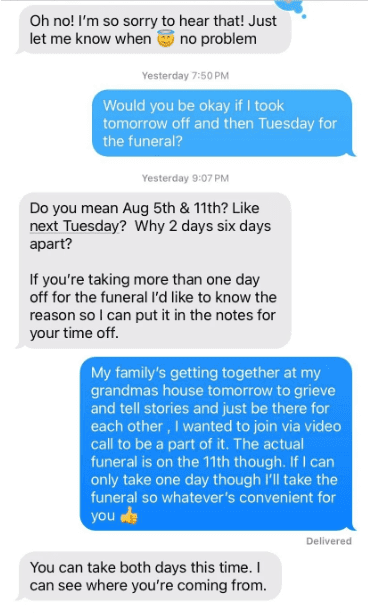
“Oh no! I’m so sorry to hear that! Just let me know when, no problem.”
The OP asked:
“Would you be okay if I took tomorrow off and then Tuesday for the funeral?”
The OP’s coworker clarified:
“Do you mean August fifth and 11th? Like next Tuesday? Why two days six days apart?”
“If you’re taking more than one day off for the funeral, I’d like to know the reason, so I can put it in the notes for your time off.”
The OP explained:
“My family’s getting together at my grandma’s house tomorrow to grieve and tell stories and just be there for each other.”
“I wanted to join via video call to be a part of it.”
“The actual funeral is on the 11th, though.”
“If I can only take one day, I’ll take the funeral, so whatever’s convenient for you.”
The OP’s coworker agreed:
“You can take both days this time.”
“I can see where you’re coming from.”
Then the OP was reprimanded by their boss for requesting time off while they were away.
The OP’s boss texted:
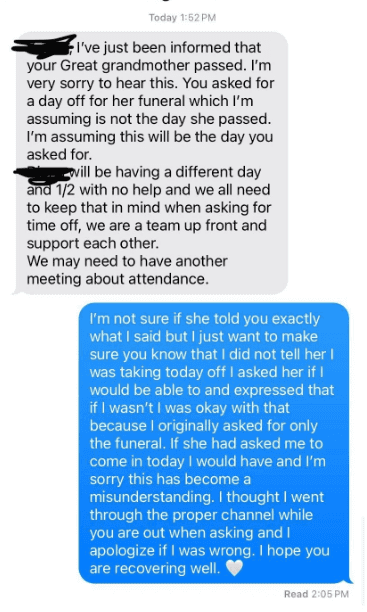
“I’ve just been informed that your great-grandmother passed. I’m very sorry to hear this.”
“You asked for a day off for her funeral, which I’m assuming is not the day she passed.”
“I’m assuming this will be the day you asked for.”
“[Employee] will be having a different day and [a half] with no help, and we all need to keep that in mind when asking for time off.”
“We are a team up front and support each other.”
“We may need to have another meeting about attendance.”
The OP clarified:
“I’m not sure if she told you exactly what I said, but I just want to make sure you know that I did not tell her I was taking today off.”
“I asked her if I would be to and expressed that if I wasn’t, I was okay with that, because I originally asked for only the funeral.”
“If she had asked me to come in today, I would have, and I’m sorry this has become a misunderstanding.”
“I thought I went through the proper channel while you were out when asking, and I apologize if I was wrong.”
According to the OP, their boss then said:
“I’m just disappointed.”
The OP was so upset by their manager’s response that they considered quitting their job.
“I feel like what she wrote was inappropriate, and today especially was not the day to say this.”
“After I explained myself, she just responded with, ‘I’m just disappointed, which just made it worse.”
“Before this, I’ve only had to take two days off when my son became sick and have been with the company for three months, passing my 90 days. We sat down to talk about attendance, to make sure I wasn’t setting up some kind of ‘precedent’ for missing work, and now my manager wants to have another meeting because of my bereavement.”
“I checked my work policy, and I am entitled to two days of bereavement, and it doesn’t state that it needs to be consecutive, and since my coworker said it was fine, I feel taking those two specific days should have been justified.”
“I feel anxious and, to be honest, disgusted with her response.”
“Would I be overreacting if I quit this job because of this? I love this job except for what happened, but I just can’t stop thinking about how disrespectful this was.”
“AIO?”
Fellow Redditors weighed in:
- NOR: Not Overreacting
- YOR: You’re Overreacting
Some Redditors were disgusted on the OP’s behalf for their manager calling them “a family” until the OP needed something.
“NOR. Meanwhile, the manager gets several weeks off to recover from surgery, and OP can’t even have two days.”
“(Of course the manager should get these weeks off, but the hypocrisy is staggering.)” – Actual_Plantain_4454
“NOR. ‘I’m just disappointed’ would throw me into a blind f**king rage. I’m sorry you’re disappointed that my family member died?? It must be so inconvenient for you??” – madagascarprincess
“Good lord… If this is a ‘team,’ then the team would rally to support their members in their time of need, not because the schedule is inconvenienced. NOR.” – RuskiesTheWarRoom
“I was at work when I got the call that my best friend had died. My team immediately told me to go home. But I didn’t really want to go sit in my thoughts yet.”
“So they supported me and said if I felt better being there with people, that was fine, but they were getting me food (because they knew I’d likely not make myself anything at home and straight up just forget to eat) and took all complicated stressful tasks and gave me the simplest, ‘don’t really need to think about it’ tasks until I was ready to leave and let it sink in.”
“They also took all my calls and told me to get things figured out and just keep them updated when I could. I’d do/ have done the same for them when things like that happen in their lives. That’s what ‘we are a team’ means.” – SwimAccomplished9487
“The difference between being a soulless middle manager who uses the word ‘team’ as a stand-in for ‘wage slave’. The ‘team’ doesn’t exist; the ‘team’ is just a guilt-trip for the gullible and to prey on people’s natural kindness. It’s manipulative bulls**t; I hope every exec and middle manager like OP’s chokes on that bulls**t.”
“‘Remember, team! We must all pull our weight and put the needs of the group (Read: corporation) above the needs of the person (you)!’ says the overweight pencil pusher who’s paid only to tell others what to do.” – Starfall0
“After getting a promotion at work a loooong time ago, I got “the call” in the middle of the night to get to the hospital for my mother. I left a message on my new boss’ voicemail that was basically, “not sure if I mentioned it, but my mother has terminal lung cancer, and I was just told to get to the hospital. I won’t be in today (it was like 3:00 AM, I think) and will call when I can.”
“Over the next two or three weeks, I was in and out. It was an awful few weeks with lots of family drama. At one point, he called me in his office just to ask me how I was doing, tell me if I needed to make any private calls to feel free to use his office and just focus on one day at a time. All the while, I was tracking my time so I could submit all the PTO sheets when I returned.”
“When she did pass away, he came to the wake and sent flowers to the funeral parlor. On Monday, when I returned to the office, I went right into his office, thanked him again for his understanding, and sat down to review how I was going to write up my PTO.”
“He took the paper, crumpled it up, and tossed it in the trash. He said he wrote down the three bereavement days for the wake and funeral and to not worry about the rest of the time. ‘Save that time for something happy and fun.'”
“I literally sat and cried in his office and couldn’t thank him enough. That’s what being a boss or part of a ‘team’ is.” – alvb
Others understood the OP wanting to quit, though they were split on whether the OP should leave so quickly.
“NOR. ‘We are a team,’ but they don’t want to support you in your grieving?? Like?? You don’t need a job that doesn’t allow you to be human.” – lolaloca6669
“NOR. It was that whole ‘we’re a team’ comment for me. True teammates are ride-or-die.”
“My assistant has been out for almost two weeks with her sick mother. I encourage her to be there as long as she needs to and don’t even make her count it as sick time. The least I can do is not make her use sick time.”
“No person wants to be in the hospital, not knowing if their mother is going to live or die. OP should find another job and completely f**k over her current employer.” – Content-Campaign-143
“When I was 23, my childhood best friend died horrifically in a car accident.”
“His only real family was his single mother, who was completely unequipped to handle the situation at all, let alone plan a funeral. I needed to take two days off, as well as intermittently step outside and take phone calls for the funeral arrangements during the week he passed.”
“My supervisor informed me that upper management was ‘looking into the situation’ and insinuating that I was taking advantage of the situation for extra time off.”
“I resigned a few weeks later. NOR.” – That-Category-9348
“NOR.”
“They are disgusting. ‘We are a team here’ is actually translated as, ‘We think of you as a functional slave who must do everything we ask without question.'”
“A true team would support each other through hardship and give you the time you need to grieve without question or guilt.”
“It’s only because of this psychopathic conditioning they’ve foisted upon us that you even question yourself in this.”
“Take the time. Don’t apologize. If they give you grief, quit. These are terrible leaders.” – The_Doctor_Bear
“NOR to WANT to quit. This is why every job should come with PTO. You shouldn’t have to plead your case and depend on some random person’s mercy to take normal time off from a job.”
“But I suggest putting the whole thing on the shelf for at least a week, then deciding what to do. What happens if you quit, could you get another job quickly? Unfortunately, crappy managers are not uncommon, and if you like everything else about the job, it may be in your interest to stay.”
“They don’t deserve it, but such is the capitalist society we live in, until we change it. Vote for change.” – Excellent-Run4803
“NOR.”
“If the company has an HR department, I would consider reaching out and saying that bereavement will be taken on these dates, and the manager heavily implied they were not going to allow me to do so without retaliation.”
“I actually had to do this for my own grandmother’s funeral because the store manager said I only got time off for immediate family like parents, siblings, and children, and the ‘team’ couldn’t spare me that day as it was a traditionally busy day of the week.”
“Grandparents, aunts, uncles, cousins, close friends, and in-laws apparently didn’t count as funerals eligible for bereavement. HR strongly disagreed, and I was able to get the time off, and the manager was sent an email reminding her of the company bereavement days policy.” – Impossible_War_2741
The subReddit reassured the OP that what they asked for was not unreasonable, even if it didn’t “make sense” to the coworkers that the two needed days were not immediately after each other. Bereavement is bereavement, and it won’t look exactly the same for everyone, and it’s unfortunately “inconvenient,” as death simply is not planned.