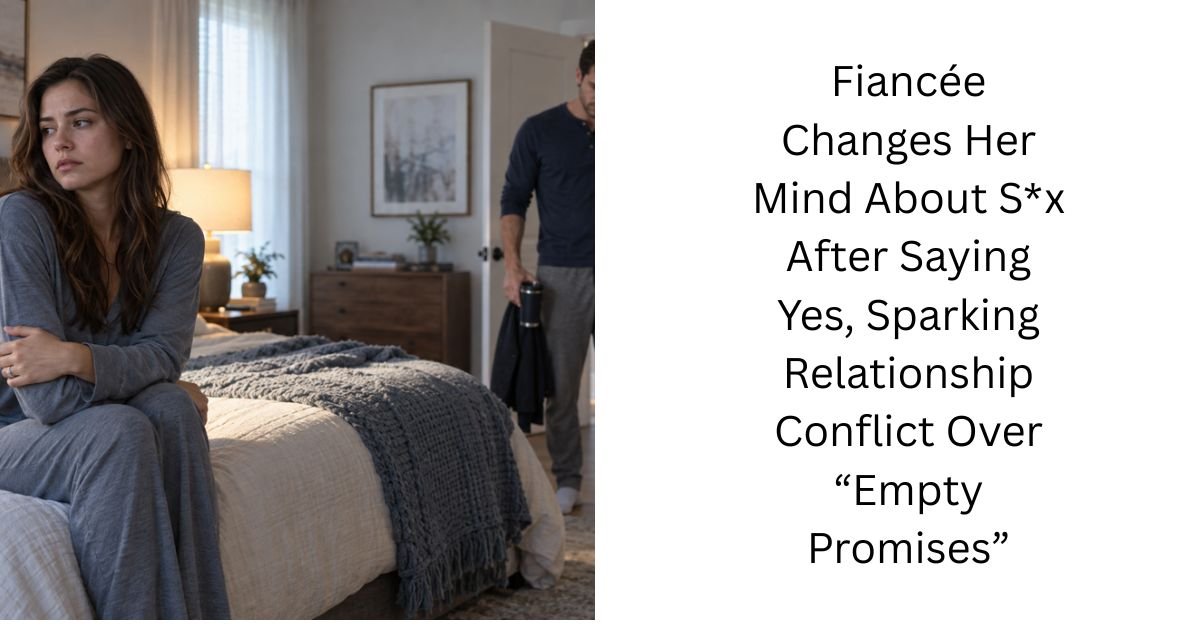
Fiancée Changes Her Mind About S*x After Saying Yes, Sparking Relationship Conflict Over “Empty Promises”
I never expected a conversation about intimacy before our wedding to create such a serious problem between my fiancée and me. We had been together for several years, and for most of our relationship, I believed we understood each other fairly well. We had talked about marriage, children, finances, where we wanted to live, and what we expected from married life. When I proposed, she said yes, and for a while everything felt like it was finally falling into place. We started making plans for the wedding and discussing what our future together would look like. During those conversations, we also talked about physical intimacy and our expectations once we were married. At the time, she seemed comfortable with those discussions and gave me the impression that we were on the same page. I never thought that her feelings would change so dramatically later.
One evening, we were discussing the wedding and what life would be like after we officially became husband and wife. The subject of intimacy came up naturally, and she told me that she was looking forward to that part of our marriage. She even gave me a clear indication that she was comfortable moving forward with it after the wedding. I took her words seriously because she was my future wife and because I trusted what she was telling me. I wasn’t trying to pressure her into anything, and I never believed that agreeing to something once meant she could never change her mind. However, because we were engaged and planning our future together, I naturally considered those conversations part of our shared expectations. I thought we had established a mutual understanding about what our relationship would look like after marriage.
Several weeks later, however, she suddenly told me that she had changed her mind. She explained that she no longer felt comfortable with the plans we had previously discussed and wanted to approach intimacy differently. At first, I told her that I respected her feelings and that she had every right to change her mind. I didn’t want her to feel pressured or obligated simply because of something she had previously said. But as we continued talking, I admitted that I was confused and disappointed. The issue wasn’t that she had changed her mind itself. What hurt was that we had spent so much time discussing our expectations, and I had made emotional decisions based on what I thought we had mutually agreed upon. Suddenly, it felt as though the future I had been imagining was no longer the future we were both planning.
She became upset when I described my feelings as disappointment. She thought I was treating her previous agreement like a promise that she was required to keep. I tried to explain that this wasn’t what I meant. I understood that consent could be withdrawn at any point, and I would never want her to do something simply because she had previously said yes. At the same time, I believed I was allowed to acknowledge that the change affected me emotionally. To me, the bigger problem was communication. If she had been uncertain all along, I wished she had told me earlier instead of speaking confidently about something she later completely reconsidered. She said that people are allowed to change their minds and that she shouldn’t have to feel guilty about it. I agreed with that principle, but I also wanted her to understand why I felt blindsided.
The argument became worse when she called my expectations “empty promises.” She said that I had apparently interpreted her earlier words as guarantees about our future, when she had only been expressing how she felt at that particular time. That phrase really bothered me because I had never thought she was deliberately lying to me. I told her that I wasn’t accusing her of deception, but from my perspective, it was difficult to hear something repeatedly, build expectations around it, and then suddenly be told that none of it should have mattered. She responded that my expectations were my responsibility, not hers. I understood what she meant, but I still felt that partners should be able to talk honestly about changing feelings without making the other person feel unreasonable for being affected by them.
After that conversation, I started questioning whether we were actually ready for marriage. It wasn’t because I expected her to follow through with something she no longer wanted. It was because our disagreement revealed that we might have very different ideas about communication, expectations, and commitment. Marriage involves countless situations where plans change. People lose jobs, move cities, change their minds about children, develop different priorities, or discover that something they once wanted no longer feels right. I believe couples need to be able to discuss those changes honestly without turning every disagreement into an accusation. I wanted to know that if something important changed for her, she would tell me openly and early rather than allowing me to continue planning around an assumption that was no longer true.
She told me that she felt I was making the situation much bigger than it needed to be. From her perspective, the answer was simple: she had changed her mind, and I needed to accept it. I told her that I did accept her decision, but accepting someone’s boundary doesn’t mean you aren’t allowed to have feelings about how the change affects the relationship. I wasn’t asking her to change her decision. I was asking for a conversation about what our new expectations would be. I wanted us to discuss whether this was a temporary change in feelings, a permanent difference in expectations, or something we needed professional help to understand together. Instead, our conversations kept turning into arguments about whether I was entitled to feel disappointed at all.
Eventually, I realized that continuing to argue about who was right wasn’t helping either of us. I told her that I didn’t want her to feel pressured, and I also didn’t want to enter a marriage where either of us felt resentful or misunderstood. We agreed to step back from the argument and have a more serious conversation about our relationship as a whole. I told her that I loved her and still cared deeply about our future, but I needed us to be honest about whether our expectations were compatible. She said she loved me too but needed me to understand that her boundaries were not something she could negotiate simply because we were engaged. That was difficult to hear, but I recognized that she was right about that part.
Now I’m left wondering what we should do before moving forward with the wedding. I don’t want to pressure her into anything, and I don’t want her to feel that saying yes to me in the past has taken away her ability to change her mind. At the same time, I don’t think either of us should ignore the fact that this disagreement has exposed a major difference between us. The real issue isn’t simply whether she changed her mind. It’s whether we can communicate about major changes without making each other feel betrayed, pressured, or dismissed. I still love her, but I’m beginning to understand that love alone doesn’t automatically resolve differences in expectations. Before we get married, I think we need to have an honest conversation about what each of us wants, what we are comfortable with, and whether we can respect each other’s boundaries while still building a future that works for both of us.
Read Story…
I 23F said to my fiance 27M we could have sex later. Then changed my mind to sleep.
I ‘23F’ have been having this ongoing issue with my fiance ‘27M’ about sex. We have been together almost a year and were friends before we got together. He sees sex as very important in a relationship, probably the most important thing whereas I find the most important thing to be connection. Yesterday I said to him that we could have sex later after he had asked me.
When it came to it was like half ten by the time we got into bed, we watched some videos together that we had sent to each other during the day. Then we got comfy and I had said I was tired and turned around. He asked me “so no sexy time then?” And I said no thank you. I’m tired. He left the room to do something and I fell asleep.
I have also started new medication that can effect my sex drive (Sertraline).
In the morning he came into the room whilst he was getting ready for his dentist appointment. He was speaking to me like he was mad at me so I asked him what it was. He went on about empty promises and how I do this all the time.
This only happens with sex, I don’t have any empty promises with anything in our relationship other than this. And when I say yes to sex. It’s not empty. I want to do it but by the time we can I’m tired and want to sleep. As I work at 9.15 and wake up at 8.
He asked me if I’ll still make dinner tonight or if I’ll change my mind about that too. I said I would make it. Then he left in a huff. So I texted him that he can sort his own dinner out. I like cooking and I’m good at it, the dinners that I make are kinda elaborate and a bit pricey. I may be an AH for telling him to do his own dinner but I was annoyed that he told me I just have empty promises so I thought, may as well make it true. These are the text messages that followed.
The Relationship We Thought We Understood
I never expected something we had discussed privately as an engaged couple to become one of the biggest sources of conflict in our relationship. My fiancée and I had been together for several years before getting engaged, and for most of that time, I genuinely believed we understood each other. We had gone through difficult periods, celebrated important milestones, supported each other through stressful situations, and eventually decided that marriage was the next step. When I proposed, she said yes, and I remember feeling like we had finally reached the point we had both been working toward. We began planning our wedding, talking about where we would live, discussing finances, and imagining what our lives would look like afterward. We also had conversations about intimacy and our expectations for married life. At the time, I believed we were both comfortable with those plans.
I want to make something clear from the beginning because this is where our disagreement became complicated. I have never believed that anyone owes another person physical intimacy simply because they previously agreed to it. Consent can change, and I understand that completely. If someone says yes today and no tomorrow, the answer tomorrow is still no. I don’t think being engaged, dating for years, or even being married changes that basic principle. My issue wasn’t that my fiancée changed her mind. What affected me was the way the change happened after we had spent months discussing our future and making plans based on what I thought were mutual expectations. I felt confused and emotionally blindsided, while she felt that I was treating a previous conversation as some kind of permanent obligation.
Before we got engaged, we had already talked about what we wanted from marriage. We weren’t teenagers casually making promises about some distant future. We were adults actively planning a life together. During those conversations, she told me that she looked forward to being physically intimate after marriage. She seemed comfortable discussing it, and there were several occasions when she reassured me that this was something she wanted as part of our married life. I never demanded a specific timeline or pressured her to prove anything to me. I simply believed what my partner was telling me. When someone you love repeatedly tells you that they want something in the future, it is natural to include that expectation when imagining your life together.
As the wedding planning became more serious, those conversations continued. We talked about our honeymoon, our first home, our routines as a married couple, and what kind of relationship we wanted to build. She spoke positively about our future, including the physical side of marriage. I remember thinking that we were unusually compatible because we could talk openly about subjects that many couples avoid. I felt lucky to have a partner who could communicate her feelings so directly. Looking back, however, I realize that I may have interpreted her confidence differently than she intended. She may have been describing how she felt at the time, while I understood those statements as an indication of what she genuinely expected to want after marriage.
Then, a few months before the wedding, something changed. My fiancée sat me down and told me that she had been thinking about our previous conversations and no longer felt comfortable with the expectations we had discussed. She said that her feelings had changed and that she needed to approach intimacy very differently. I remember being quiet for a moment because I wasn’t sure how to respond. I asked if something had happened or if I had done something that made her uncomfortable. She said there wasn’t necessarily one specific event. She simply didn’t feel the same way anymore and didn’t want to continue planning around the assumptions we had previously made.
My first reaction was to tell her that I respected her decision. I didn’t want my disappointment to make her feel pressured. I told her that she had every right to change her mind and that I would never want her to do something against her wishes. She seemed relieved initially, but then our conversation became more complicated. I admitted that I was struggling emotionally with the sudden change. I wasn’t asking her to reverse her decision. I simply wanted her to understand that hearing something different after months of believing we had the same expectations was difficult for me. She interpreted my disappointment as pressure, while I interpreted her reaction as a refusal to acknowledge the impact her change had on me.
The argument became more intense when she said I was acting as though she had broken a promise. I told her that, in a sense, I had believed our repeated conversations represented a mutual understanding about our future. She immediately pushed back and said that she had never signed a contract with me. According to her, she had simply told me what she wanted at the time, and she was allowed to discover that she wanted something different later. I agreed that she could change her mind, but I tried to explain that I wasn’t calling her a liar. I was trying to understand how we had gone from seemingly sharing the same expectations to being completely different on such an important part of marriage.
She then used the phrase that has stayed in my head ever since: “empty promises.” She said she felt like I was treating her previous words as promises that she was now required to fulfill. She told me that she didn’t want to be trapped by things she had said months earlier. Hearing that hurt because I had never intended to trap her. At the same time, I couldn’t pretend those conversations had meant nothing to me. I had trusted her words. I had allowed myself to become excited about our future based partly on those discussions. If she had always been uncertain, I would have preferred to know that uncertainty existed rather than believing we were completely aligned.
I told her that I understood the difference between consent and commitment. I knew she could say no at any point. What I wanted to discuss was whether our relationship still had compatible expectations. I wasn’t asking, “How do I convince you to change your mind?” I was asking, “What does this change mean for our future, and are we still compatible?” She seemed to hear the first question instead of the second. She became defensive and said she shouldn’t have to justify a boundary to me. I told her she didn’t need to justify the boundary itself, but we did need to communicate about how it affected our relationship.
That distinction became extremely important to me. I didn’t want her to feel obligated to do anything physical. I also didn’t want to be told that I wasn’t allowed to have feelings about a major change in our relationship. Both things could be true at the same time. She could have complete control over her own boundaries, and I could still feel disappointed, confused, or concerned about compatibility. I tried explaining this several times, but every attempt seemed to turn into another argument. She heard my disappointment as guilt or pressure, while I heard her refusal to discuss the issue as emotional dismissal.
Eventually, we stopped talking about the wedding altogether for several days. This was particularly difficult because invitations had already been discussed, relatives knew about the engagement, and plans were underway. Every time someone asked us about the wedding, we had to pretend everything was fine. Behind closed doors, however, we were struggling to have a basic conversation without becoming frustrated. I started wondering whether getting married while this unresolved tension existed would be a mistake. It wasn’t just about intimacy anymore. It was about whether we could handle major changes in expectations without damaging our trust.
One night, I asked her whether she still wanted to marry me. That question made her very emotional. She told me that she loved me and still wanted a future with me, but she didn’t want marriage to come with expectations that made her feel obligated. I told her that I didn’t want that either. I wanted a marriage where both people felt safe saying what they wanted and what they didn’t want. But I also wanted a marriage where both people could openly discuss whether their needs were compatible. I didn’t think it was fair to ignore the issue simply because the subject was uncomfortable.
She asked me why I couldn’t just accept that her answer had changed and move forward. I told her that I was accepting her answer. What I couldn’t do was pretend the change didn’t matter to me. If one person in a relationship suddenly changes their position on something significant, the other person is naturally going to have questions. That doesn’t mean they are entitled to override the decision. It means they are trying to understand the new reality. I wanted us to figure out what our relationship would look like under those new circumstances before we legally committed ourselves to each other.
She accused me of making marriage conditional on physical intimacy. That wasn’t how I saw it, although I understood why she might interpret my concern that way. I told her that marriage involves compatibility in many different areas, including communication, finances, children, lifestyle, affection, and intimacy. Nobody owes anyone a particular behavior, but both people deserve the opportunity to decide whether the relationship meets their needs. If our expectations were fundamentally different, that didn’t make either of us a bad person. It simply meant we might have a difficult decision to make before the wedding.
That conversation forced me to think more carefully about what I actually wanted. At first, I had been focused on the fact that she had changed her mind. But after sitting with it for several days, I realized that the bigger issue was trust. I had believed her when she told me what she wanted. Now I wondered whether I had misunderstood her or whether she had been saying things she wasn’t completely certain about. I didn’t want to spend the rest of our marriage questioning whether her words were genuine. I needed to know that when we discussed our future, we were both being honest about what we actually felt rather than saying whatever made the conversation easier.
She told me that she had also been thinking about my side of the situation. She admitted that she could understand why I felt disappointed, even though she still believed her decision was completely valid. She said she hadn’t intended to mislead me and that when she made those earlier statements, she genuinely believed she wanted the future we had discussed. Her feelings had simply changed. That explanation helped me somewhat because it removed the idea that she had deliberately deceived me. I realized that perhaps I had been expecting certainty from a person who had never actually promised that her feelings could never change.
At the same time, I told her that she needed to understand why the change affected my confidence in our compatibility. I wasn’t angry because she said no. I was concerned because something we had previously viewed as an important part of our future had suddenly become something she didn’t want to discuss in the same way. I needed to know whether this was a temporary period of uncertainty or whether our long-term expectations were fundamentally different. She couldn’t give me a clear answer, and that uncertainty was difficult for both of us.
We eventually discussed postponing the wedding. Neither of us wanted to admit that possibility because our families were already involved and a lot of planning had taken place. But we both recognized that going ahead simply because canceling or postponing would be embarrassing wasn’t a good reason to get married. A wedding is one day. A marriage is supposed to last much longer. If we couldn’t have an honest conversation about something this important, it seemed irresponsible to pretend everything would magically work itself out after the ceremony.
My family noticed that something was wrong, although I didn’t give them the private details. I simply told them that we were having relationship difficulties and needed some time. Her family, however, seemed to have a different reaction. One of her relatives apparently told her that I was being unreasonable and that she shouldn’t marry someone who expected her to keep promises about intimacy. I understood why they would defend her, but I also felt frustrated that people were reducing the situation to something much simpler than it actually was. I wasn’t demanding anything from her. I was trying to decide whether our relationship could survive a significant change in expectations.
Eventually, we agreed that talking to a couples counselor before getting married would be the healthiest option. Neither of us wanted someone to convince the other person to change. We wanted help communicating without turning every conversation into a fight. During one of our first discussions, we were encouraged to separate boundaries from relationship compatibility. That distinction changed the way I viewed the entire situation. Her boundary was hers, and I had no right to negotiate it. My decision about whether I could happily remain in a relationship under those circumstances was mine. Neither of those rights canceled out the other.
The counseling also helped us understand why the phrase “empty promises” had been so damaging to both of us. She felt accused of breaking a commitment she believed she had never made. I felt as though something I had sincerely believed was part of our shared future had been dismissed as meaningless. We were using the same words but assigning completely different meanings to them. Once we understood that, some of the anger began to disappear. We still disagreed, but we were finally discussing the actual problem instead of accusing each other of having bad intentions.
I also had to acknowledge my own mistake. I had treated our previous conversations as more definite than they really were. I had assumed that because we had discussed something repeatedly, it meant our future was guaranteed to unfold that way. That assumption wasn’t entirely fair. People can change their minds, even about things they once felt certain about. I realized that I could respect her right to change without pretending that the change had no consequences for me. The mature response wasn’t to pressure her or punish her. It was to decide whether the new situation was something I could genuinely accept.
She, in turn, acknowledged that although she had every right to change her mind, she could have communicated her uncertainty earlier. She admitted that she had avoided bringing up her changing feelings because she was afraid I would be disappointed. Ironically, avoiding the conversation had made the eventual conflict much worse. I told her that I would always rather hear an uncomfortable truth early than a comfortable answer that later changes unexpectedly. That became one of the most important lessons for both of us.
Our wedding plans are currently on hold while we work through everything. I don’t know whether we will eventually get married, and I’m trying not to force myself to know the answer immediately. Part of me still hopes we can rebuild the understanding we once had. Another part of me recognizes that love isn’t the only thing a successful marriage requires. We need compatible expectations, honest communication, and the ability to respect each other’s boundaries without resentment. If we can’t achieve those things, postponing the wedding may ultimately be the right decision.
I don’t regret telling her how I felt, but I do regret some of the language I used during our first argument. Saying that she had “promised” something made her feel as though I believed her previous consent created an obligation. That was never what I intended, but I understand now why she reacted so strongly. At the same time, I don’t think I should have been expected to hide my disappointment simply to prove that I respected her boundary. Healthy communication should leave room for both people to have emotions while still respecting consent.
Looking back, I think the real conflict was never simply about sex. It was about what happens when two people enter a marriage with different expectations. We had both imagined our future in certain ways, and then one of those expectations changed. She needed me to understand that her body and boundaries were always her own. I needed her to understand that changes in expectations could affect how I viewed our compatibility. Neither of us was completely wrong, but neither of us could solve the problem by simply insisting that our own perspective was the only one that mattered.
For now, we’re taking things slowly. There is no wedding date we’re rushing toward, and neither of us is trying to force a final answer before we’re ready. I still love my fiancée, and I genuinely hope we can work through this. But I have also learned that getting married just because you’ve already announced an engagement is not a good enough reason. If we eventually move forward, I want it to be because we both feel heard, respected, and comfortable with the relationship we’re actually building—not because we’re trying to preserve the future we imagined months ago.
The hardest part of this entire situation is accepting that neither of us can control the other person’s feelings. She can’t be forced to want something simply because she once said she wanted it, and I can’t be forced to feel completely unaffected by her change of heart. We both have choices to make. She gets to establish her boundaries, and I get to decide what kind of relationship I can genuinely be happy in. If we can respect those truths without blaming each other, there may still be a future for us. If we can’t, then perhaps discovering that before the wedding is painful but necessary. Either way, I would rather have an honest relationship built on current reality than a marriage based on promises that neither person truly understands in the same way.